SARS Now Enforcing Income Tax Numbers for All Tax Filings
The South African Revenue Service (SARS) has officially tightened compliance requirements for the 2025 filing season.
From now on, all tax submissions must include a valid income tax reference number — no exceptions.
This means that:
Employers must ensure all employees on their payroll have registered income tax numbers before submitting EMP501 reconciliations and IRP5/IT3(a) certificates.
Individuals must have a valid income tax number when submitting their personal returns on eFiling or via the SARS MobiApp.
New taxpayers who have never registered should do so as soon as possible through SARS eFiling or by visiting a SARS branch.
SARS has made it clear that returns submitted without income tax numbers will be rejected, and employers may face penalties for non-compliance.
This enforcement aligns with SARS’s ongoing drive to improve data integrity, prevent fraud, and ensure accurate taxpayer records.
✅ What Employers Should Do
Audit your payroll to ensure every employee has a valid tax number.
Assist staff in registering if they do not have one.
Update employee records before the next filing submission.
✅ What Employees Should Do
Check your payslip or SARS correspondence for your tax number.
If you don’t have one, register immediately — it’s free and can be done online.
📌 Reminder: SARS uses income tax numbers to match taxpayer information accurately and streamline compliance across PAYE, UIF, and personal income tax systems.
Stay compliant. Avoid penalties. Register today.
For more details, contact us and we can help you stay compaint.
jade@1acct.co.za/ 0823874944

Finalising Your Financials , Why the 6-Month Deadline After Year-End Matters More Than You Think
Your year-end is over, congrats! But before you pop the champagne, remember this: the real countdown has begun. South African companies have six months after their year-end to finalise and submit their financial statements. If your year-end was in February, your deadline is end of August.
Let’s explore why finalising your financials is critical, and how 1Acct can help you get it done right, the first time.
What Does “Finalising Financials” Actually Mean?
Finalisation means:
- All accounts are closed and balanced
- Adjustments are made (depreciation, provisions, accruals)
- Financial statements are prepared in accordance with IFRS or IFRS for SMEs
- Statements are signed off by a qualified professional
It’s not just about having a spreadsheet that “looks close enough.” SARS and CIPC require formally prepared financials.
Why Is This Deadline So Important?
- Compliance
- Required by the Companies Act
- Essential for SARS and CIPC submissions
- Protects your business from audit risks or fines
- Business Credibility
- Needed for tenders, funding, and investor interest
- Reflects the financial health and legitimacy of your business
- Strategic Planning
- Informs your tax position, provisional payments, and forecasting
- Allows for better decision-making going forward
What Happens If You Miss It?
- Non-compliance flags at SARS and CIPC
- Delays in VAT refunds or tax clearance certificates
- Penalties, audit risk, or even deregistration
What Do You Need to Prepare?
- Bank statements
- Invoices (sales and purchases)
- Asset register
- Loan agreements
- Payroll reports
- Previous financials
- Tax numbers and eFiling access
How 1Acct Makes Finalising Easy
Our team at 1Acct has helped hundreds of South African businesses:
- Compile and finalise financial statements
- Prepare management reports and audit packs
- Submit to SARS and CIPC on your behalf
- Stay on top of financial reporting all year round
We also offer cloud accounting and monthly packages to make tax season less stressful, every year.
Act Before It’s Too Late
If your year-end was in February, the clock is ticking. Don’t wait until the final week to get started.
👉 Speak to 1Acct today and we’ll help you finalise with accuracy, speed, and compliance.
Finalising Your Financials , Why the 6-Month Deadline After Year-End Matters More Than You Think
Your year-end is over, congrats! But before you pop the champagne, remember this: the real countdown has begun. South African companies have six months after their year-end to finalise and submit their financial statements. If your year-end was in February, your deadline is end of August.
Let’s explore why finalising your financials is critical, and how 1Acct can help you get it done right, the first time.
What Does “Finalising Financials” Actually Mean?
Finalisation means:
- All accounts are closed and balanced
- Adjustments are made (depreciation, provisions, accruals)
- Financial statements are prepared in accordance with IFRS or IFRS for SMEs
- Statements are signed off by a qualified professional
It’s not just about having a spreadsheet that “looks close enough.” SARS and CIPC require formally prepared financials.
Why Is This Deadline So Important?
- Compliance
- Required by the Companies Act
- Essential for SARS and CIPC submissions
- Protects your business from audit risks or fines
- Business Credibility
- Needed for tenders, funding, and investor interest
- Reflects the financial health and legitimacy of your business
- Strategic Planning
- Informs your tax position, provisional payments, and forecasting
- Allows for better decision-making going forward
What Happens If You Miss It?
- Non-compliance flags at SARS and CIPC
- Delays in VAT refunds or tax clearance certificates
- Penalties, audit risk, or even deregistration
What Do You Need to Prepare?
- Bank statements
- Invoices (sales and purchases)
- Asset register
- Loan agreements
- Payroll reports
- Previous financials
- Tax numbers and eFiling access
How 1Acct Makes Finalising Easy
Our team at 1Acct has helped hundreds of South African businesses:
- Compile and finalise financial statements
- Prepare management reports and audit packs
- Submit to SARS and CIPC on your behalf
- Stay on top of financial reporting all year round
We also offer cloud accounting and monthly packages to make tax season less stressful, every year.
Act Before It’s Too Late
If your year-end was in February, the clock is ticking. Don’t wait until the final week to get started.
👉 Speak to 1Acct today and we’ll help you finalise with accuracy, speed, and compliance.
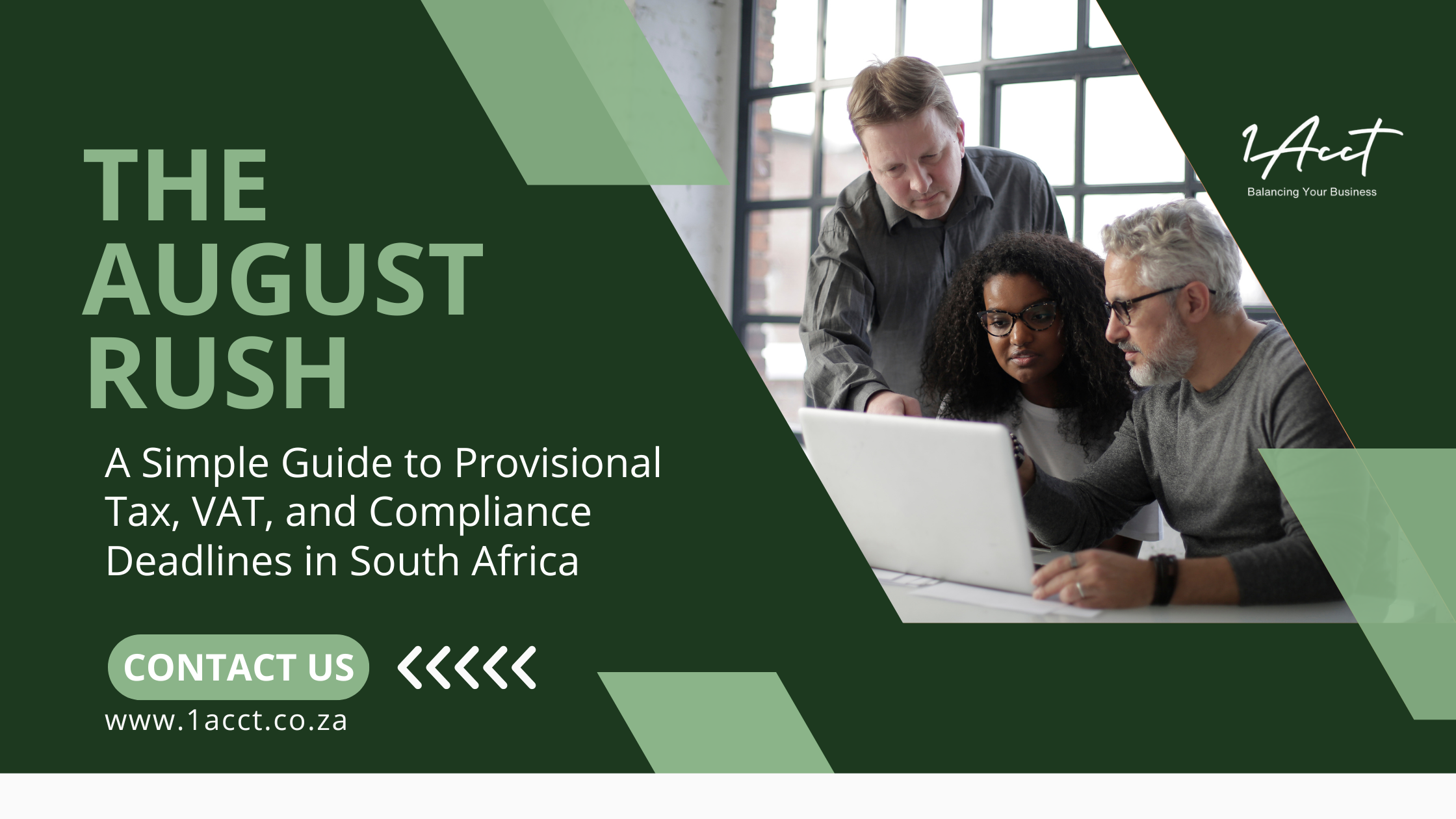 The August Rush , A Simple Guide to Provisional Tax, VAT, and Compliance Deadlines in South Africa
August isn’t just another month, it’s the financial ‘make-or-break’ period for thousands of South African businesses. Between VAT submissions, provisional tax, and prepping interim IRP5s, the pressure is on to meet SARS deadlines and stay compliant. At 1Acct, we know how overwhelming this period can be, especially for small-to-medium businesses. So we’ve created a simple, clear guide to help you manage the chaos and stay ahead.
Key Deadlines to Know
- 25 August 2025:
🔸 VAT returns due for:- Bi-monthly registrations (June–July 2025)
- Monthly VAT returns (July 2025)
- 31 August 2025:
🔸 First Provisional Tax Submission for 2026 tax year
What is Provisional Tax, and Why Should You Care?
Provisional tax is not a separate tax, but rather a way of paying your income tax liability in advance, in two (sometimes three) instalments. It’s compulsory for companies and individuals who earn income outside of regular employment (like freelancers, directors, and small businesses).
Why it matters:
- Late or inaccurate submissions can result in penalties and interest.
- It shows SARS that your business is responsible and compliant.
- It makes your final tax payment smaller and easier to manage.
Tips to Submit Provisional Tax Like a Pro
- Always base your income estimate on realistic projections, not guesses.
- Keep your bookkeeping up to date to avoid estimation errors.
- Use SARS eFiling or work with a tax professional (like 1Acct) to avoid costly mistakes.
- If you’ve made a loss, you still need to submit. Non-submission is not an option.
VAT – The One Deadline That Never Slows Down
VAT submissions are non-negotiable. If you’re VAT-registered, bi-monthly and monthly submissions must be filed accurately and timeously.
Here’s what you’ll need:
- Your full set of VAT invoices
- Supporting purchase documentation
- A VAT reconciliation report
Common mistake: Claiming VAT on non-VAT registered supplier invoices = red flag for SARS.
Don’t Forget Your Interim IRP5s
While not due in August, IRP5 submissions begin to gain momentum in September. It’s wise to start preparing your payroll summaries and employee earnings data now to avoid bottlenecks later.
Final Checklist for August Compliance
- Provisional Tax Calculation Ready
- VAT Invoices Captured and Reconciled
- All Accounting Records Updated
- IRP5 Payroll Data in Progress
- Tax Practitioner Booked?
Why Work with 1Acct?
At 1Acct, we specialise in helping South African businesses:
- Prepare, review, and submit tax returns
- Stay up to date with SARS changes
- Avoid penalties and audit risk
- Manage accounting without lifting a finger
💬 Need help getting your submissions done before the deadline?
👉 Contact 1Acct now to let us handle your compliance, while you focus on running your business.
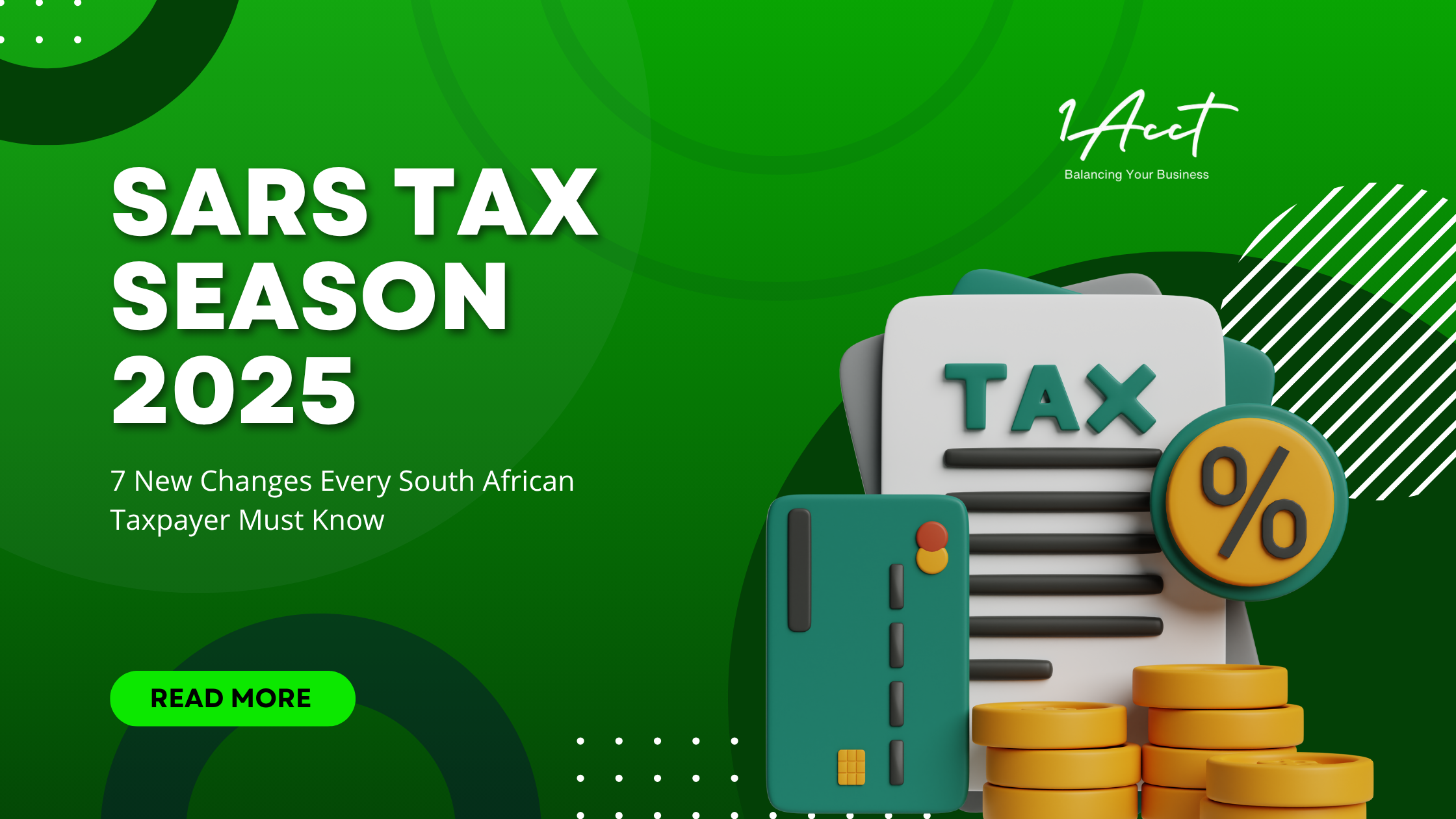
SARS Tax Season 2025: 7 New Changes Every South African Taxpayer Must Know
The 2025 SARS Tax Season (1 July–24 October) brings sweeping changes that could cost unaware taxpayers thousands in missed refunds or penalties. After analyzing SARS’ latest directives, we’ve identified the 7 most impactful updates, and how to navigate them.
*”Last year, 62% of auto-assessments had errors,”* says SARS Commissioner Edward Kieswetter. “Taxpayers must review submissions carefully.”
- Crypto Asset Reporting is Now Mandatory
What Changed?
- All crypto trades (even under R50,000) must be declared under new Schedule 6D.
- Exchanges like Luno will auto-report to SARS.
Action Step:
✔ Gather records of all 2024/25 transactions (buy/sell dates, amounts, wallet addresses).
- Auto-Assessments Now Include Rental Income
What Changed?
SARS auto-assessments previously excluded rental earnings, now they’re automatically added.
Danger: If you’ve already declared rentals elsewhere, this could cause duplicate taxation.
Action Step:
✔ Cross-check IRP5s vs. auto-assessment figures.
- Higher Penalties for Late Submissions
New Rates:
- 10% of tax due (up from 5%) if filed after deadline.
- Additional 1% monthly interest.
Pro Tip: Set reminders for:
- Provisional Tax: 31 August 2025
- Final Submissions: 24 October 2025
- Flat-Rate WFH Deduction (New Option)
Simplified Claim:
- R250/month home office rate (no proof required).
- OR Detailed calculation (per existing rules).
Best For:
- Employees earning <R500k/year: Flat rate saves time.
- High-income earners: Itemized claims may yield more.
- Medical Tax Credit Adjustments
New Thresholds:
- Over-65s: Credits increased by 8%.
- Disabled Persons: Submit new AMAFA Form B for 2025.
- Side Hustle Spotlight
SARS now data-matches:
- Etsy/Fiverr earnings
- Airbnb income
- Freelance invoices
Red Flag: Unreported income triggers automated audit letters.
- Dispute Process Upgrades
New eFiling Feature:
- Upload supporting docs directly in disputes.
- Track status via “Request History” tab.
Need Help?
Our Tax Season Package includes:
✅ Pre-submission review
✅ Penalty dispute support
✅ Refund maximization
📞 Book a Consultation or download our free 2025 Tax Checklist [here].
How to Dispute a SARS Auto-Assessment (2025 Step-by-Step Guide)
In 2024, 42% of auto-assessments contained errors (SARS Annual Report). With 2025’s expanded auto-assessment system (now including rentals and crypto), mistakes are even likelier. Here’s how to fight back.
Step 1: Verify the Error
Common auto-assessment mistakes:
- Duplicate income (e.g., IRP5 + rental declared twice)
- Missing deductions (medical, retirement)
- Incorrect crypto gains
Pro Tip: Compare against your:
- IRP5
- Bank statements
- Crypto transaction history
Step 2: Start Your Dispute (Screenshots)
- Log into eFiling → “Auto-Assessment” tab.
- Click “Dispute” next to incorrect items.
- Upload evidence:
- PDFs (bank statements)
- Screenshots (crypto apps)
- Signed letters (employer corrections)
Step 3: Track & Follow Up
- Check “Request History” for updates.
- SARS must respond within 21 days (new 2025 rule).
Warning: If unresolved, penalties accrue after 40 days.
When to Call Professionals
Dispute fails? We’ve successfully overturned R2.1m in incorrect assessments by:
✔ Drafting PAJA appeals
✔ Liaising directly with SARS auditors
💡 Free Tip: DM us a screenshot of your assessment for a quick error check.
Finalising Your Financials , Why the 6-Month Deadline After Year-End Matters More Than You Think
Your year-end is over, congrats! But before you pop the champagne, remember this: the real countdown has begun. South African companies have six months after their year-end to finalise and submit their financial statements. If your year-end was in February, your deadline is end of August.
Let’s explore why finalising your financials is critical, and how 1Acct can help you get it done right, the first time.
What Does “Finalising Financials” Actually Mean?
Finalisation means:
- All accounts are closed and balanced
- Adjustments are made (depreciation, provisions, accruals)
- Financial statements are prepared in accordance with IFRS or IFRS for SMEs
- Statements are signed off by a qualified professional
It’s not just about having a spreadsheet that “looks close enough.” SARS and CIPC require formally prepared financials.
Why Is This Deadline So Important?
- Compliance
- Required by the Companies Act
- Essential for SARS and CIPC submissions
- Protects your business from audit risks or fines
- Business Credibility
- Needed for tenders, funding, and investor interest
- Reflects the financial health and legitimacy of your business
- Strategic Planning
- Informs your tax position, provisional payments, and forecasting
- Allows for better decision-making going forward
What Happens If You Miss It?
- Non-compliance flags at SARS and CIPC
- Delays in VAT refunds or tax clearance certificates
- Penalties, audit risk, or even deregistration
What Do You Need to Prepare?
- Bank statements
- Invoices (sales and purchases)
- Asset register
- Loan agreements
- Payroll reports
- Previous financials
- Tax numbers and eFiling access
How 1Acct Makes Finalising Easy
Our team at 1Acct has helped hundreds of South African businesses:
- Compile and finalise financial statements
- Prepare management reports and audit packs
- Submit to SARS and CIPC on your behalf
- Stay on top of financial reporting all year round
We also offer cloud accounting and monthly packages to make tax season less stressful, every year.
Act Before It’s Too Late
If your year-end was in February, the clock is ticking. Don’t wait until the final week to get started.
👉 Speak to 1Acct today and we’ll help you finalise with accuracy, speed, and compliance.
Finalising Your Financials , Why the 6-Month Deadline After Year-End Matters More Than You Think
Your year-end is over, congrats! But before you pop the champagne, remember this: the real countdown has begun. South African companies have six months after their year-end to finalise and submit their financial statements. If your year-end was in February, your deadline is end of August.
Let’s explore why finalising your financials is critical, and how 1Acct can help you get it done right, the first time.
What Does “Finalising Financials” Actually Mean?
Finalisation means:
- All accounts are closed and balanced
- Adjustments are made (depreciation, provisions, accruals)
- Financial statements are prepared in accordance with IFRS or IFRS for SMEs
- Statements are signed off by a qualified professional
It’s not just about having a spreadsheet that “looks close enough.” SARS and CIPC require formally prepared financials.
Why Is This Deadline So Important?
- Compliance
- Required by the Companies Act
- Essential for SARS and CIPC submissions
- Protects your business from audit risks or fines
- Business Credibility
- Needed for tenders, funding, and investor interest
- Reflects the financial health and legitimacy of your business
- Strategic Planning
- Informs your tax position, provisional payments, and forecasting
- Allows for better decision-making going forward
What Happens If You Miss It?
- Non-compliance flags at SARS and CIPC
- Delays in VAT refunds or tax clearance certificates
- Penalties, audit risk, or even deregistration
What Do You Need to Prepare?
- Bank statements
- Invoices (sales and purchases)
- Asset register
- Loan agreements
- Payroll reports
- Previous financials
- Tax numbers and eFiling access
How 1Acct Makes Finalising Easy
Our team at 1Acct has helped hundreds of South African businesses:
- Compile and finalise financial statements
- Prepare management reports and audit packs
- Submit to SARS and CIPC on your behalf
- Stay on top of financial reporting all year round
We also offer cloud accounting and monthly packages to make tax season less stressful, every year.
Act Before It’s Too Late
If your year-end was in February, the clock is ticking. Don’t wait until the final week to get started.
👉 Speak to 1Acct today and we’ll help you finalise with accuracy, speed, and compliance.
The August Rush , A Simple Guide to Provisional Tax, VAT, and Compliance Deadlines in South Africa
August isn’t just another month, it’s the financial ‘make-or-break’ period for thousands of South African businesses. Between VAT submissions, provisional tax, and prepping interim IRP5s, the pressure is on to meet SARS deadlines and stay compliant. At 1Acct, we know how overwhelming this period can be, especially for small-to-medium businesses. So we’ve created a simple, clear guide to help you manage the chaos and stay ahead.
Key Deadlines to Know
- 25 August 2025:
🔸 VAT returns due for:- Bi-monthly registrations (June–July 2025)
- Monthly VAT returns (July 2025)
- 31 August 2025:
🔸 First Provisional Tax Submission for 2026 tax year
What is Provisional Tax, and Why Should You Care?
Provisional tax is not a separate tax, but rather a way of paying your income tax liability in advance, in two (sometimes three) instalments. It’s compulsory for companies and individuals who earn income outside of regular employment (like freelancers, directors, and small businesses).
Why it matters:
- Late or inaccurate submissions can result in penalties and interest.
- It shows SARS that your business is responsible and compliant.
- It makes your final tax payment smaller and easier to manage.
Tips to Submit Provisional Tax Like a Pro
- Always base your income estimate on realistic projections, not guesses.
- Keep your bookkeeping up to date to avoid estimation errors.
- Use SARS eFiling or work with a tax professional (like 1Acct) to avoid costly mistakes.
- If you’ve made a loss, you still need to submit. Non-submission is not an option.
VAT – The One Deadline That Never Slows Down
VAT submissions are non-negotiable. If you’re VAT-registered, bi-monthly and monthly submissions must be filed accurately and timeously.
Here’s what you’ll need:
- Your full set of VAT invoices
- Supporting purchase documentation
- A VAT reconciliation report
Common mistake: Claiming VAT on non-VAT registered supplier invoices = red flag for SARS.
Don’t Forget Your Interim IRP5s
While not due in August, IRP5 submissions begin to gain momentum in September. It’s wise to start preparing your payroll summaries and employee earnings data now to avoid bottlenecks later.
Final Checklist for August Compliance
- Provisional Tax Calculation Ready
- VAT Invoices Captured and Reconciled
- All Accounting Records Updated
- IRP5 Payroll Data in Progress
- Tax Practitioner Booked?
Why Work with 1Acct?
At 1Acct, we specialise in helping South African businesses:
- Prepare, review, and submit tax returns
- Stay up to date with SARS changes
- Avoid penalties and audit risk
- Manage accounting without lifting a finger
💬 Need help getting your submissions done before the deadline?
👉 Contact 1Acct now to let us handle your compliance, while you focus on running your business.
SARS Tax Season 2025: 7 New Changes Every South African Taxpayer Must Know
The 2025 SARS Tax Season (1 July–24 October) brings sweeping changes that could cost unaware taxpayers thousands in missed refunds or penalties. After analyzing SARS’ latest directives, we’ve identified the 7 most impactful updates, and how to navigate them.
*”Last year, 62% of auto-assessments had errors,”* says SARS Commissioner Edward Kieswetter. “Taxpayers must review submissions carefully.”
- Crypto Asset Reporting is Now Mandatory
What Changed?
- All crypto trades (even under R50,000) must be declared under new Schedule 6D.
- Exchanges like Luno will auto-report to SARS.
Action Step:
✔ Gather records of all 2024/25 transactions (buy/sell dates, amounts, wallet addresses).
- Auto-Assessments Now Include Rental Income
What Changed?
SARS auto-assessments previously excluded rental earnings, now they’re automatically added.
Danger: If you’ve already declared rentals elsewhere, this could cause duplicate taxation.
Action Step:
✔ Cross-check IRP5s vs. auto-assessment figures.
- Higher Penalties for Late Submissions
New Rates:
- 10% of tax due (up from 5%) if filed after deadline.
- Additional 1% monthly interest.
Pro Tip: Set reminders for:
- Provisional Tax: 31 August 2025
- Final Submissions: 24 October 2025
- Flat-Rate WFH Deduction (New Option)
Simplified Claim:
- R250/month home office rate (no proof required).
- OR Detailed calculation (per existing rules).
Best For:
- Employees earning <R500k/year: Flat rate saves time.
- High-income earners: Itemized claims may yield more.
- Medical Tax Credit Adjustments
New Thresholds:
- Over-65s: Credits increased by 8%.
- Disabled Persons: Submit new AMAFA Form B for 2025.
- Side Hustle Spotlight
SARS now data-matches:
- Etsy/Fiverr earnings
- Airbnb income
- Freelance invoices
Red Flag: Unreported income triggers automated audit letters.
- Dispute Process Upgrades
New eFiling Feature:
- Upload supporting docs directly in disputes.
- Track status via “Request History” tab.
Need Help?
Our Tax Season Package includes:
✅ Pre-submission review
✅ Penalty dispute support
✅ Refund maximization
📞 Book a Consultation or download our free 2025 Tax Checklist [here].
How to Dispute a SARS Auto-Assessment (2025 Step-by-Step Guide)
In 2024, 42% of auto-assessments contained errors (SARS Annual Report). With 2025’s expanded auto-assessment system (now including rentals and crypto), mistakes are even likelier. Here’s how to fight back.
Step 1: Verify the Error
Common auto-assessment mistakes:
- Duplicate income (e.g., IRP5 + rental declared twice)
- Missing deductions (medical, retirement)
- Incorrect crypto gains
Pro Tip: Compare against your:
- IRP5
- Bank statements
- Crypto transaction history
Step 2: Start Your Dispute (Screenshots)
- Log into eFiling → “Auto-Assessment” tab.
- Click “Dispute” next to incorrect items.
- Upload evidence:
- PDFs (bank statements)
- Screenshots (crypto apps)
- Signed letters (employer corrections)
Step 3: Track & Follow Up
- Check “Request History” for updates.
- SARS must respond within 21 days (new 2025 rule).
Warning: If unresolved, penalties accrue after 40 days.
When to Call Professionals
Dispute fails? We’ve successfully overturned R2.1m in incorrect assessments by:
✔ Drafting PAJA appeals
✔ Liaising directly with SARS auditors
💡 Free Tip: DM us a screenshot of your assessment for a quick error check.
Finalising Your Financials , Why the 6-Month Deadline After Year-End Matters More Than You Think
Your year-end is over, congrats! But before you pop the champagne, remember this: the real countdown has begun. South African companies have six months after their year-end to finalise and submit their financial statements. If your year-end was in February, your deadline is end of August.
Let’s explore why finalising your financials is critical, and how 1Acct can help you get it done right, the first time.
What Does “Finalising Financials” Actually Mean?
Finalisation means:
- All accounts are closed and balanced
- Adjustments are made (depreciation, provisions, accruals)
- Financial statements are prepared in accordance with IFRS or IFRS for SMEs
- Statements are signed off by a qualified professional
It’s not just about having a spreadsheet that “looks close enough.” SARS and CIPC require formally prepared financials.
Why Is This Deadline So Important?
- Compliance
- Required by the Companies Act
- Essential for SARS and CIPC submissions
- Protects your business from audit risks or fines
- Business Credibility
- Needed for tenders, funding, and investor interest
- Reflects the financial health and legitimacy of your business
- Strategic Planning
- Informs your tax position, provisional payments, and forecasting
- Allows for better decision-making going forward
What Happens If You Miss It?
- Non-compliance flags at SARS and CIPC
- Delays in VAT refunds or tax clearance certificates
- Penalties, audit risk, or even deregistration
What Do You Need to Prepare?
- Bank statements
- Invoices (sales and purchases)
- Asset register
- Loan agreements
- Payroll reports
- Previous financials
- Tax numbers and eFiling access
How 1Acct Makes Finalising Easy
Our team at 1Acct has helped hundreds of South African businesses:
- Compile and finalise financial statements
- Prepare management reports and audit packs
- Submit to SARS and CIPC on your behalf
- Stay on top of financial reporting all year round
We also offer cloud accounting and monthly packages to make tax season less stressful, every year.
Act Before It’s Too Late
If your year-end was in February, the clock is ticking. Don’t wait until the final week to get started.
👉 Speak to 1Acct today and we’ll help you finalise with accuracy, speed, and compliance.
The August Rush , A Simple Guide to Provisional Tax, VAT, and Compliance Deadlines in South Africa
August isn’t just another month, it’s the financial ‘make-or-break’ period for thousands of South African businesses. Between VAT submissions, provisional tax, and prepping interim IRP5s, the pressure is on to meet SARS deadlines and stay compliant. At 1Acct, we know how overwhelming this period can be, especially for small-to-medium businesses. So we’ve created a simple, clear guide to help you manage the chaos and stay ahead.
Key Deadlines to Know
- 25 August 2025:
🔸 VAT returns due for:- Bi-monthly registrations (June–July 2025)
- Monthly VAT returns (July 2025)
- 31 August 2025:
🔸 First Provisional Tax Submission for 2026 tax year
What is Provisional Tax, and Why Should You Care?
Provisional tax is not a separate tax, but rather a way of paying your income tax liability in advance, in two (sometimes three) instalments. It’s compulsory for companies and individuals who earn income outside of regular employment (like freelancers, directors, and small businesses).
Why it matters:
- Late or inaccurate submissions can result in penalties and interest.
- It shows SARS that your business is responsible and compliant.
- It makes your final tax payment smaller and easier to manage.
Tips to Submit Provisional Tax Like a Pro
- Always base your income estimate on realistic projections, not guesses.
- Keep your bookkeeping up to date to avoid estimation errors.
- Use SARS eFiling or work with a tax professional (like 1Acct) to avoid costly mistakes.
- If you’ve made a loss, you still need to submit. Non-submission is not an option.
VAT – The One Deadline That Never Slows Down
VAT submissions are non-negotiable. If you’re VAT-registered, bi-monthly and monthly submissions must be filed accurately and timeously.
Here’s what you’ll need:
- Your full set of VAT invoices
- Supporting purchase documentation
- A VAT reconciliation report
Common mistake: Claiming VAT on non-VAT registered supplier invoices = red flag for SARS.
Don’t Forget Your Interim IRP5s
While not due in August, IRP5 submissions begin to gain momentum in September. It’s wise to start preparing your payroll summaries and employee earnings data now to avoid bottlenecks later.
Final Checklist for August Compliance
- Provisional Tax Calculation Ready
- VAT Invoices Captured and Reconciled
- All Accounting Records Updated
- IRP5 Payroll Data in Progress
- Tax Practitioner Booked?
Why Work with 1Acct?
At 1Acct, we specialise in helping South African businesses:
- Prepare, review, and submit tax returns
- Stay up to date with SARS changes
- Avoid penalties and audit risk
- Manage accounting without lifting a finger
💬 Need help getting your submissions done before the deadline?
👉 Contact 1Acct now to let us handle your compliance, while you focus on running your business.
SARS Tax Season 2025: 7 New Changes Every South African Taxpayer Must Know
The 2025 SARS Tax Season (1 July–24 October) brings sweeping changes that could cost unaware taxpayers thousands in missed refunds or penalties. After analyzing SARS’ latest directives, we’ve identified the 7 most impactful updates, and how to navigate them.
*”Last year, 62% of auto-assessments had errors,”* says SARS Commissioner Edward Kieswetter. “Taxpayers must review submissions carefully.”
- Crypto Asset Reporting is Now Mandatory
What Changed?
- All crypto trades (even under R50,000) must be declared under new Schedule 6D.
- Exchanges like Luno will auto-report to SARS.
Action Step:
✔ Gather records of all 2024/25 transactions (buy/sell dates, amounts, wallet addresses).
- Auto-Assessments Now Include Rental Income
What Changed?
SARS auto-assessments previously excluded rental earnings, now they’re automatically added.
Danger: If you’ve already declared rentals elsewhere, this could cause duplicate taxation.
Action Step:
✔ Cross-check IRP5s vs. auto-assessment figures.
- Higher Penalties for Late Submissions
New Rates:
- 10% of tax due (up from 5%) if filed after deadline.
- Additional 1% monthly interest.
Pro Tip: Set reminders for:
- Provisional Tax: 31 August 2025
- Final Submissions: 24 October 2025
- Flat-Rate WFH Deduction (New Option)
Simplified Claim:
- R250/month home office rate (no proof required).
- OR Detailed calculation (per existing rules).
Best For:
- Employees earning <R500k/year: Flat rate saves time.
- High-income earners: Itemized claims may yield more.
- Medical Tax Credit Adjustments
New Thresholds:
- Over-65s: Credits increased by 8%.
- Disabled Persons: Submit new AMAFA Form B for 2025.
- Side Hustle Spotlight
SARS now data-matches:
- Etsy/Fiverr earnings
- Airbnb income
- Freelance invoices
Red Flag: Unreported income triggers automated audit letters.
- Dispute Process Upgrades
New eFiling Feature:
- Upload supporting docs directly in disputes.
- Track status via “Request History” tab.
Need Help?
Our Tax Season Package includes:
✅ Pre-submission review
✅ Penalty dispute support
✅ Refund maximization
📞 Book a Consultation or download our free 2025 Tax Checklist [here].
How to Dispute a SARS Auto-Assessment (2025 Step-by-Step Guide)
In 2024, 42% of auto-assessments contained errors (SARS Annual Report). With 2025’s expanded auto-assessment system (now including rentals and crypto), mistakes are even likelier. Here’s how to fight back.
Step 1: Verify the Error
Common auto-assessment mistakes:
- Duplicate income (e.g., IRP5 + rental declared twice)
- Missing deductions (medical, retirement)
- Incorrect crypto gains
Pro Tip: Compare against your:
- IRP5
- Bank statements
- Crypto transaction history
Step 2: Start Your Dispute (Screenshots)
- Log into eFiling → “Auto-Assessment” tab.
- Click “Dispute” next to incorrect items.
- Upload evidence:
- PDFs (bank statements)
- Screenshots (crypto apps)
- Signed letters (employer corrections)
Step 3: Track & Follow Up
- Check “Request History” for updates.
- SARS must respond within 21 days (new 2025 rule).
Warning: If unresolved, penalties accrue after 40 days.
When to Call Professionals
Dispute fails? We’ve successfully overturned R2.1m in incorrect assessments by:
✔ Drafting PAJA appeals
✔ Liaising directly with SARS auditors
💡 Free Tip: DM us a screenshot of your assessment for a quick error check.
South Africa’s 2025 Budget Speech: Navigating Fiscal Tightropes Amidst Political Turbulence
On May 21, 2025, Finance Minister Enoch Godongwana presented South Africa’s third budget iteration for the year, a testament to the nation’s challenging fiscal landscape and political complexities. This budget, shaped by coalition dynamics and economic constraints, aims to address revenue shortfalls while attempting to maintain essential public services.
Key Highlights from the 2025 Budget Speech
- Fuel Levy Increase: A New Burden on Consumers
In an effort to bolster revenue without increasing the Value-Added Tax (VAT), the government announced an inflation-linked hike in the general fuel levy. Starting June 4, 2025, petrol prices will see a 16 cents per litre increase, while diesel will rise by 15 cents per litre. This marks the first fuel levy adjustment in three years and is expected to impact transportation costs and, subsequently, the prices of goods and services across the board.
- Cuts to Education and Health Funding
Significant reductions have been made to education and health budgets. Additional spending for education has been reduced from R29.5 billion to R19.5 billion, affecting initiatives aimed at safeguarding approximately 5,500 teaching posts. Similarly, health funding has been slashed, with allocations dropping from R28.9 billion to R20.7 billion. These cuts raise concerns about the government’s ability to maintain quality public services in these critical sectors.
- Abandonment of the VAT Increase
Initially, the government proposed a phased VAT increase to address a projected R75 billion shortfall. However, facing strong opposition from coalition partners and the public, the plan was abandoned, keeping the VAT rate at 15%. This decision, while politically expedient, leaves a significant gap in the nation’s revenue projections.
- Widening Budget Deficit and Debt Concerns
The budget deficit is now expected to widen to 4.8% of GDP, up from the previously projected 4.6%. Gross debt is anticipated to stabilize at 77.4% of GDP in the 2025/26 fiscal year, reflecting the fiscal pressures stemming from the scrapped VAT hike and reduced economic growth projections.
- Political Ramifications: Coalition Strains
The budget’s passage has strained the coalition government, with the Democratic Alliance (DA) opposing the VAT increase and other fiscal measures. The ANC’s decision to proceed without DA support has led to tensions that threaten the stability of the coalition, raising questions about the government’s ability to implement its fiscal agenda effectively.
Implications for South Africans
The 2025 budget reflects the government’s attempt to balance fiscal responsibility with political realities. However, the increased fuel levy and cuts to essential services may disproportionately affect lower-income households, exacerbating existing inequalities. The abandonment of the VAT increase, while politically motivated, leaves a significant revenue gap that may necessitate future tax hikes or further spending cuts.
Conclusion
South Africa’s 2025 budget underscores the challenges of fiscal management within a complex political landscape. While the government aims to maintain economic stability and service delivery, the measures introduced may have far-reaching consequences for the nation’s socio-economic fabric. Stakeholders and citizens alike will need to navigate these changes carefully, advocating for policies that promote both fiscal responsibility and social equity.